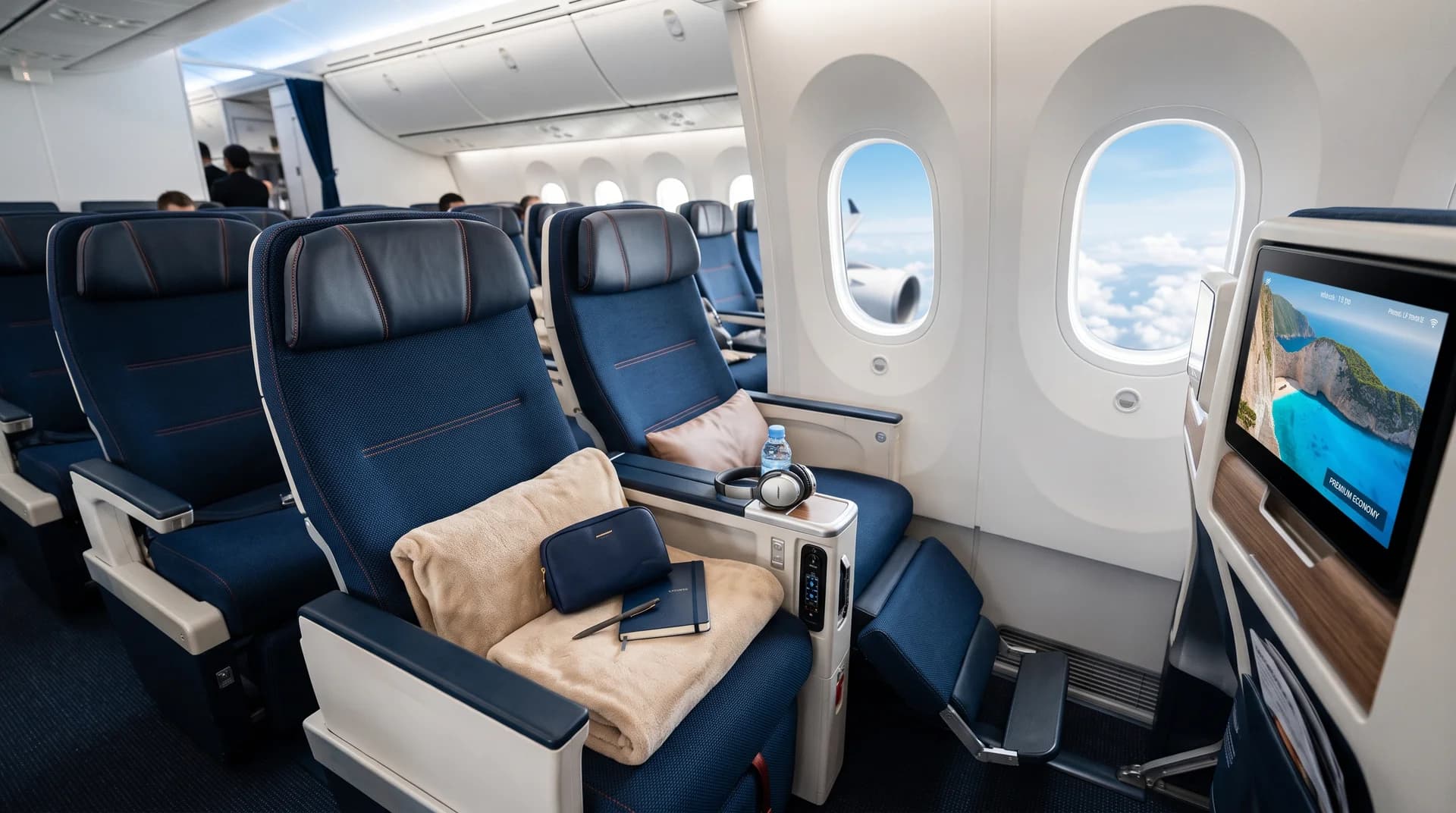
September 2026: the middle cabin moves to the front
In the space of three days in early September, premium economy generated more announcements than the entire spring. On 1 September, Emirates opened its Premium Economy cabin on two of its three daily rotations between Dubai and Mauritius: flights EK703/704 on the A380 and EK709/710 on a refurbished Boeing 777. On 3 September, the airline unveiled a seat billed as a world first for the class, with a full-height divider that rises and locks electrically between every place.
What was actually announced
The seat is installed on the A350s delivered this year, in a 2-3-2 layout, in a cabin of just 28 places. Emirates quotes 20 inches of seat width and up to 39 inches of pitch, roughly 51 cm and 99 cm. Recline works in a cradle position without intruding on the row behind, and adjustment runs through an electric control unit with preset positions. It is the airline's first fully electrically powered premium economy product.
A shift far wider than Dubai
In the same week, JetBlue presented its new domestic forward cabin and American Airlines showed a Boeing 777-300ER reconfigured with 144 seats up front. Air New Zealand put numbers on its own pivot: more than 34,000 additional seats to North America and around 20,500 premium seats added across its long-haul network. These are no longer experiments; they reflect a durable reallocation of cabin floor space.
Why airlines care so much
The answer is not comfort, it is revenue per square metre. Lufthansa has called premium economy a money-generating machine, and says it earns roughly 33% more per unit of floor area than economy, and even 6% more than business class. A premium seat takes barely more room than an economy seat, sells for considerably more, and ties up neither the galley nor the crew of a business cabin.
Growth ahead of economy
In recent years premium economy has grown at around 8% a year against roughly 5.9% for economy, making it the fastest-rising cabin. The financial backdrop explains the urgency. In its forecast published in December 2025, IATA expects the industry to post a net profit of 41 billion dollars in 2026 on total revenue of 1,053 billion, a net margin of 3.9% and about 7.90 dollars earned per passenger carried. With margins that thin, every better-monetised row counts.
What you are actually buying
The orders of magnitude are now consistent from airline to airline. Expect 94 to 107 cm of pitch against 78 to 81 cm in long-haul economy, a seat widened by two to five centimetres, a leg rest, an adjustable headrest, a larger screen and a more generous baggage allowance, often two pieces where economy permits one.
European fleets catching up
Air France has completed the refit of its twelve Boeing 777-300ERs. The Premium cabin there offers, according to the airline, up to 124 degrees of recline, a 13.3-inch 4K touchscreen and 94 to 97 cm of legroom. But part of the remaining long-haul fleet still flies the previous generation of fixed-shell seats, whose comfort is appreciably lower: the name of the class tells you nothing about the product you will get.
What it is not
It is not discounted business class. No flat bed, no lounge, no systematic priority lane. On an overnight flight you will sleep sitting up, better supported, but sitting up. The drinks service, so often foregrounded in the brochures, is the worst possible reason to buy: cabin air is very dry and alcohol worsens dehydration, and therefore fatigue on arrival. What you are paying for is centimetres and a baggage allowance.
The price gap at which it holds up
The market sits in a fairly clear band: premium economy generally sells at 1.5 to 2.5 times the economy fare for the same date. A Paris-New York return advertised at around 530 euros in economy frequently comes out near 1,000 to 1,030 euros in Premium. At French bee, the Premium cabin starts around 630 euros return depending on the season.
The ten-hour rule
The premium should be judged against time spent seated, not the prestige of the cabin. Under six hours of flying, the gap is rarely defensible: you are mostly buying a baggage allowance that a paid bag option covers for far less. Between six and ten hours, a premium below 40 to 50% of the economy fare holds up, especially if you work the next day. Beyond ten hours, premium economy becomes the most profitable line on the ticket. Once the price passes double the economy fare, however, compare it with discounted business: the gap is sometimes narrower than expected, and if it is not, the money is better kept for the trip itself.
The family arithmetic
For four people, the maths changes in nature. A 300-euro premium per person becomes 1,200 euros, often several nights of accommodation. The middle path works better: book economy and target a forward row or an exit row for the adults, or upgrade only one leg, the overnight return that lands before school starts again.
Three checks before you pay
First, check the aircraft rather than the class: the same booking code covers seats from two generations, and the cabin plans published by the airline settle it in two minutes. Next, look at the paid upgrade offered after purchase, at check-in or by bid: it is frequently half the gap shown at booking, at the cost of uncertainty. Finally, compare the mileage price with the cash price: on premium cabins the value of a mile is often better than in business, where taxes and surcharges absorb part of the gain.
The middle cabin is no longer a commercial trial, it is long-haul's new centre of gravity. The task now is to pay for it only when the hours in the air, rather than the brochure, justify it.