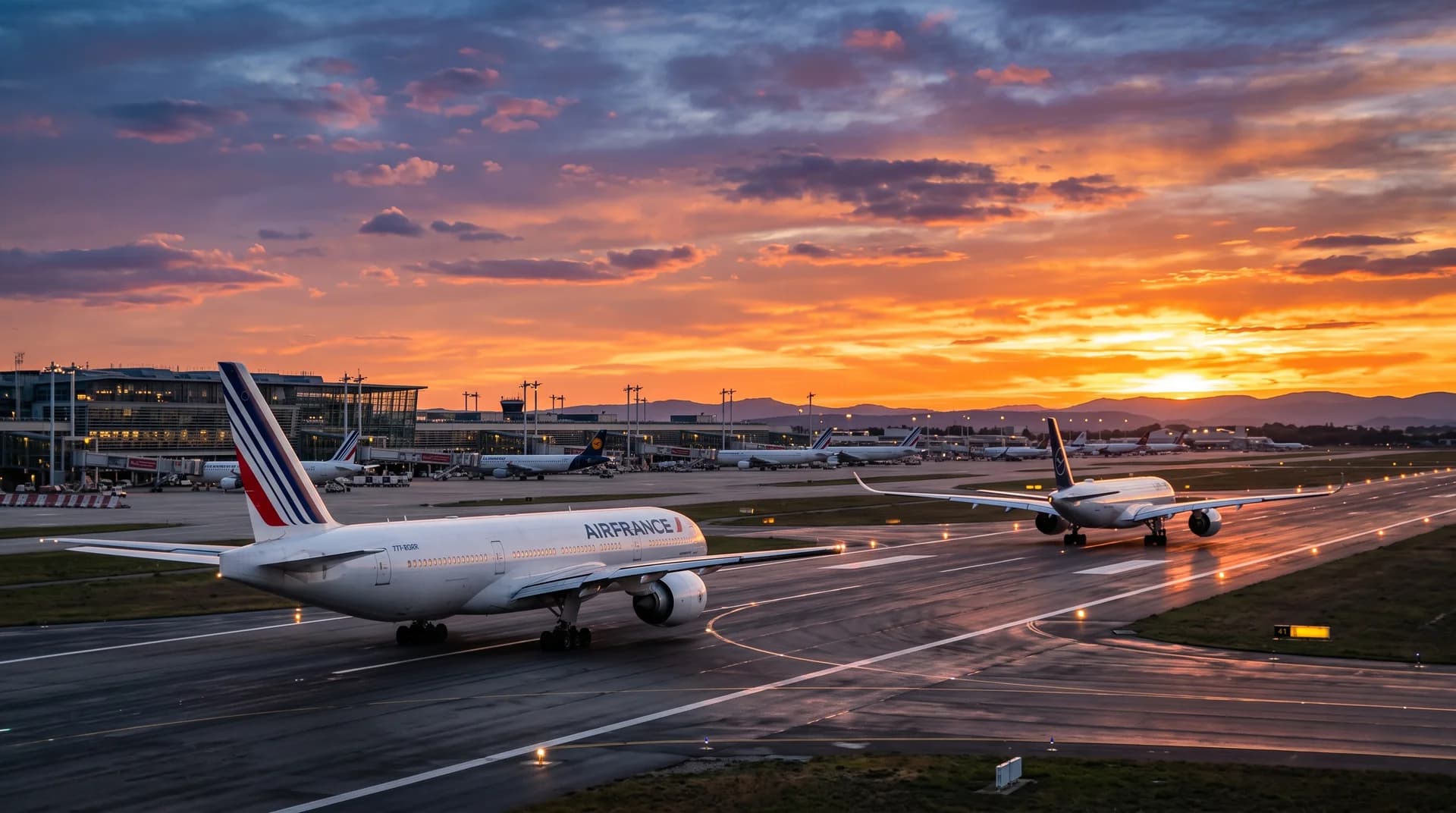
On 25 October, aviation switches seasons overnight
The airline winter season opens on Sunday 25 October 2026 and runs until Saturday 27 March 2027. This is no harmless piece of admin: it is the night flight programmes flip over, airport slots are redistributed and schedules published months ago stop being valid. A ticket bought in July for the Christmas holidays may suddenly leave twenty minutes earlier, change terminal, lose a comfortable connection — or vanish from the schedule altogether.
The same night, Europe puts its clocks back: overnight from Saturday 24 to Sunday 25 October, 3am becomes 2am. Airlines build their new programme around that winter time. That is why schedule changes all land at once, and why "booking amended" emails pile up in the autumn.
The week the Atlantic shifts
North America does not move to winter time until 1 November. For one week, from 25 October to 1 November, the gap between Paris and New York narrows to five hours instead of six. Transatlantic flights keep their local departure time but land an hour earlier or later than expected depending on the direction — enough to turn a 1h15 connection into a sprint, or an "early evening" arrival into a late-night one with children in tow. For that specific week, reread your itinerary line by line rather than trusting your memory of the summer.
What opens: winter moves towards the sun
The underlying trend is clear: airlines no longer shrink in November, they move their aircraft south.
Low-cost carriers push their pieces forward
On 17 July, Ryanair announced its largest ever winter programme: 80 million seats, around 1,700 routes across 35 countries, including more than 140 new ones, with a marked push into Central and Eastern Europe, North Africa and its Irish and Scandinavian bases. In early August it detailed a record Moroccan programme linking the country to fourteen European markets. Transavia France is opening Cairo, Seville and Cape Verde, adding two regional routes — Brest–Seville and Rennes–Seville, twice weekly each — and extending nine existing routes beyond the summer. easyJet is thickening around ten French routes from half a dozen airports, overwhelmingly towards Egypt, Morocco and the Iberian Peninsula, with Agadir and Essaouira added.
Long-haul: seasonal routes pinned to school holidays
On long-haul, the openings come with exact dates, and that matters when booking. Air France flies Paris-Charles de Gaulle–Malé from 18 December 2026 to 8 March 2027, Punta Cana from 30 November 2026 to 27 March 2027, and adds Mauritius frequencies between 3 November and 6 December. La Compagnie extends its Nice–New York route through the winter. In Canada, Air Transat adds four routes, including Toronto–Fort-de-France and Charlottetown–Punta Cana. Knowing those boundaries avoids the classic mistake: searching for a direct flight a week before the seasonal route starts, and concluding it "doesn't exist".
What closes, thins out or pauses
The flip side gets far less coverage. From 25 October, ITA Airways drops two weekly frequencies on Rome Fiumicino–Algiers. easyJet, while expanding towards Morocco, is temporarily suspending two routes in mid-winter: no flights at all between Basel-Mulhouse and Tangier from 20 January to 11 February 2027, and a three-to-four-week pause on London Southend–Marrakech.
January gaps, the blind spot of booking engines
These pauses are not cancellations: the route exists, it simply is not operated for a few very low-season weeks. The booking engine, however, shows nothing — which reads like an error or a closed route. The useful reflex: when a direct link disappears from results over a short window, test a date two weeks earlier and two weeks later before falling back on a connecting itinerary.
Already holding a ticket: the switchover checklist
A schedule change is not a cancellation, and the two are handled differently. In practice, three moves cover most cases.
- Reopen your booking in October, on the airline's website rather than in the confirmation email: after the switchover, the online record is what counts.
- Check connection times if the trip involves two flights, especially between 25 October and 1 November on the Atlantic, and whenever the airport or terminal changes.
- Recheck family seating and special baggage: an aircraft swap reassigns seats, and grouped allocations routinely break.
When a shifted schedule opens up rights
If the airline removes your flight and rebooks you, you keep the choice between the rerouting offered and a refund — including when the new timing suits you badly. A significant shift, an added stop or an airport change can be challenged: put it in writing as soon as the change notice arrives, quoting the booking reference and the original schedule. That is the window in which airlines most readily rebook at no cost.
Booking for winter 2026-27: what the calendar changes
Two practical markers. First, the inventory is now fully loaded: what you see today for February is the final programme, give or take adjustments, not a skeleton that will fill out later. Second, the troughs are where they always were — the second half of January and the first half of February, outside school holidays, carry the lowest fares, precisely because some routes pause there.
Then there is industrial action, which does not vanish with the summer: in Spain, controllers at private provider SAERCO have kept up a dispute since April affecting nine airports, and Norway saw a controllers' strike in late August that closed Oslo Gardermoen to scheduled commercial traffic for several hours. Across a winter, you manage that with margin: first flight of the day, connections of at least two hours, and never a return the day before school starts.